A practical guide to how insurers assess a business, evaluate its buyers and provide cover against unpaid invoices.
Most businesses insure their vehicles, buildings and equipment. Trade credit insurance protects another major asset: the money owed by customers.
Trade credit insurance can sometimes feel like a complex financial product. Yet most business owners already understand a similar concept: car insurance. While the comparison is not exact, it provides a useful way to explain how trade credit insurance works. For businesses seeking a more detailed overview, our guide to trade credit insurance explained with working examples explores how policies operate in real-world scenarios.
How trade credit insurers assess your business
When you apply for car insurance, the insurer starts by looking at you as the driver. It wants to understand your overall risk profile before agreeing to provide cover.
- Have you had any accidents?
- Have you made previous claims?
- Where do you live?
- Where is the car kept overnight?
- Do you drive only in the UK or abroad?
- How often do you drive?
Trade credit insurance works in much the same way. When a business applies for cover, the insurer builds a picture of the company and how it trades.
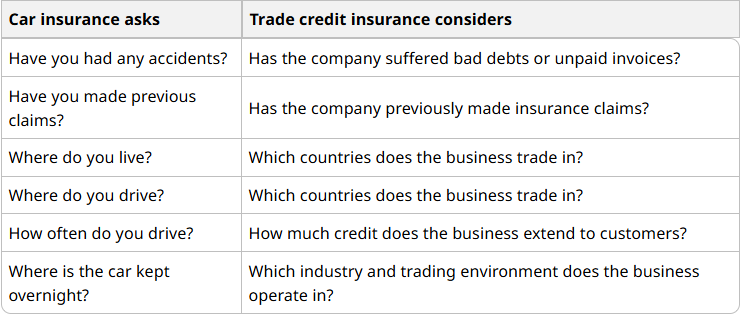
These factors help the insurer answer a basic question: how risky is this business to insure? A company trading mainly with established UK customers may present a different risk profile from one operating across several international markets or in sectors under economic pressure.
How trade credit insurers assess customer risk
Now imagine you own a fleet of vehicles. You would not expect an insurer to assess every car in the same way. A family hatchback and a high-performance sports car present different risks.
Trade credit insurance follows the same principle. Each customer, or buyer, that you want to cover must be considered individually. Think of every buyer in your customer portfolio as a separate vehicle.
Many businesses perform their own business credit checks before extending trade credit. However, trade credit insurers often assess a wider range of financial, sector, and market information when evaluating buyer risk.
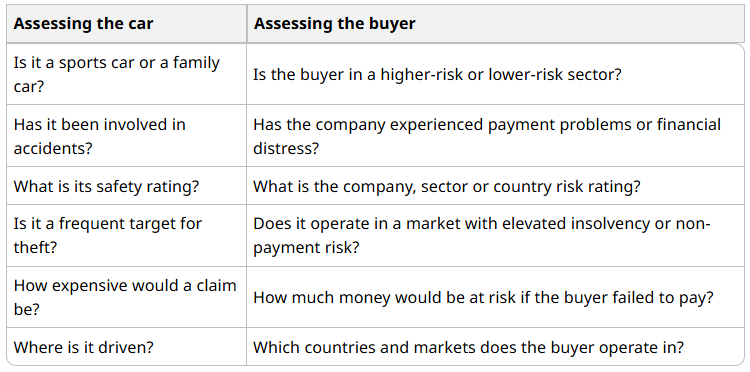
Just as every vehicle presents a different level of risk, every buyer presents a different level of credit risk.
The insurer is trying to understand how likely each buyer is to experience financial difficulties that could prevent it from paying suppliers, and how large the potential loss could be. This process forms part of a wider company risk assessment, helping insurers evaluate both the likelihood and potential impact of customer non-payment.
Why credit limits are important in trade credit insurance
This is one of the most common questions about trade credit insurance: if a business has already paid its premium, why does it also need credit limits?
Paying a premium would not normally mean that a car insurer automatically agrees to cover every vehicle you own, regardless of its type, history, value or condition. Before covering a vehicle, the insurer needs to understand the risk it presents.
The same applies to trade credit insurance. The insurer may have assessed your business as the policyholder, but it must still assess each buyer that you want covered. A financially strong company with a long trading history and a record of paying suppliers on time presents a different risk from a company showing signs of financial pressure.
Trade credit insurance premiums and credit limits explained
The premium pays for the insurer to assess, monitor and cover risk. The credit limit process determines which specific buyer risks the insurer is prepared to cover, and to what level.
A credit limit is not a second insurance policy. It is the insurer’s underwriting decision for a specific buyer, based on the information available at the time.
Once the buyer has been assessed, the insurer may:
- approve the requested credit limit;
- approve a lower amount;
- request further information; or
- decline cover where the risk is too high.
This can be frustrating when the buyer is important to your business, particularly if you have traded with it for years and believe you understand it well. But this is also where the car insurance analogy reaches an important limit.
Car insurance is largely passive: the insurer provides cover and responds if an accident happens. Trade credit insurance is proactive. The insurer continually monitors customers, sectors and countries and may have access to financial, payment and market information that is not available to an individual supplier.
That broader view can allow the insurer to make a more informed assessment of a buyer’s risk. A reduced, partially approved or declined credit limit should therefore be treated as a risk signal, not simply as a lack of cover.
If you do not receive the credit limit you want, the better question may be: “What does the insurer know that I do not?”
The decision may indicate that the buyer’s circumstances or wider trading environment have changed. It should prompt a conversation about the reasons for the decision and whether further information is available. The purpose is not to prevent trade. It is to identify risk before an unpaid invoice becomes a loss.
Why customer risk and credit exposure change over time
Businesses, sectors, countries and economic conditions change. A buyer that appeared financially strong twelve months ago may face very different circumstances today due to changes in demand, rising costs, sector pressures or wider economic developments. Trade credit insurers therefore continuously monitor buyer risk and may review their underwriting decisions as new information becomes available.
This is one reason why trade credit insurance is not simply about protection against loss. Ongoing assessment and monitoring can provide valuable insight into changing customer circumstances, helping businesses make more informed decisions about who they trade with, how much credit they extend and where potential risks may be emerging.
Insurance ultimately exists for the point at which something goes wrong. With car insurance, a claim may follow an accident. With trade credit insurance, a claim may arise when a covered customer does not pay an eligible outstanding debt or becomes insolvent.
Where the buyer has not paid but remains trading, indemnification is not necessarily the first step. The insurer can use its debt collection network to pursue the outstanding amount. Successful collection may speed up recovery and can return up to 100% of the covered debt, less applicable debt collection costs, rather than the 90% indemnification payable under the policy.
If collection is unsuccessful and the debt meets the policy requirements, the insurer pays indemnification in line with the agreed terms. This helps reduce the effect of the unpaid invoice on cash flow.
In an insolvency, there is no pre-indemnification debt collection stage because the buyer is subject to a formal insolvency process. The claim therefore proceeds through the relevant insolvency and policy procedures.
Trade credit insurance does more than respond to a loss. It monitors risk before non-payment and, where appropriate, attempts recovery before indemnification.
How Trade Credit Insurance Helps Businesses Manage Risk
Most businesses would not think twice about insuring vehicles, buildings or equipment. Yet the money owed by customers can also be one of the largest assets on a company’s balance sheet.
Trade credit insurance helps protect that asset while giving a business access to external analysis of the customers to which it extends credit.
Trade credit insurance is like insuring a fleet of vehicles. The insurer first assesses you as the driver, then checks every customer as if it were an individual vehicle. Unlike motor insurance, it also monitors those risks and can act before and after non-payment.
The analogy is simple, but it captures the central idea: understand and manage the risk before an unpaid invoice becomes a financial loss.
Important note: This article provides a general explanation only. Credit limit decisions, collection activity, recovery allocation, claim eligibility and indemnification depend on the terms and conditions of the relevant policy.
Related Reading
Looking to learn more about trade credit insurance and managing customer payment risk?